

Introduction
Artificial intelligence is transforming how businesses manage information, automate tasks, and deliver digital services. As AI applications become more advanced, the need for reliable connections between AI models, business software, and external data sources continues to grow. The Model Context Protocol (MCP) is emerging as a practical solution to this challenge.
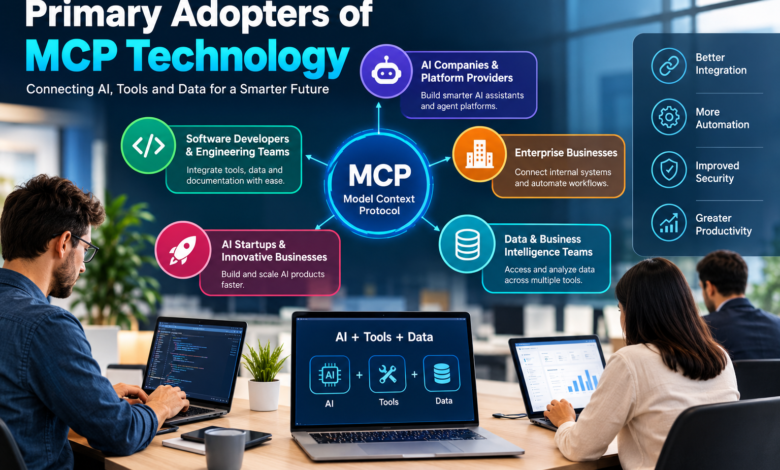
The primary adopters of mcp technology include software developers, technology companies, enterprise organizations, AI startups, and businesses looking to improve automation. By providing a standardized way for AI applications to interact with external tools and information, MCP can simplify integration and support more useful AI-powered workflows.
What Is MCP Technology?
Model Context Protocol is an open protocol designed to help AI applications connect with external data sources, tools, and services through a standardized interface. Instead of building separate integrations for every application, developers can use compatible MCP servers to make resources available to supported AI clients.
For example, an AI assistant could connect to a company’s internal documents, project management software, or database through an appropriate MCP integration. This connection allows the assistant to retrieve relevant information or use permitted tools, depending on the integration’s capabilities and access controls.
MCP does not replace AI models or business software. Instead, it provides a common communication layer that can make connections between them easier to develop and maintain.
1. Software Developers and Engineering Teams
Software developers are among the most important early users of MCP. They frequently work with multiple development tools, repositories, documentation systems, testing environments, and databases. Connecting these resources to AI assistants can help streamline everyday tasks.
Developers can use compatible integrations to retrieve documentation, inspect project information, search code, or interact with development tools. This can reduce repetitive work and help teams spend more time solving technical problems.
For engineering organizations, MCP also offers a reusable integration approach. Rather than maintaining numerous custom connections, teams can build or adopt standardized servers for supported services.
2. AI Companies and Platform Providers
AI companies are another major group adopting MCP-related capabilities. AI assistants become more useful when they can access relevant information and interact with external services instead of relying exclusively on information provided in a conversation.
The primary adopters of mcp technology in this category include organizations building AI assistants, agent platforms, and productivity applications. MCP can help these providers connect their products with compatible third-party tools and business systems.
However, adoption varies by platform. Not every AI provider supports every MCP feature, and developers must verify compatibility before implementing an integration.
3. Enterprise Businesses
Large businesses often operate across several departments, each using different applications and information systems. Employees may need to search internal documents, review project updates, analyze records, and retrieve customer information throughout the working day.
MCP can help enterprises connect supported resources to AI assistants through controlled integrations. For example, a team might create an assistant that retrieves approved company policies or searches project documentation.
Organizations can also use this approach to explore workflow automation. Nevertheless, enterprise adoption requires careful planning, including permission management, data protection, monitoring, and compliance with internal policies.
4. AI Startups and Innovative Businesses
Startups frequently need to develop useful products without spending excessive time building infrastructure. MCP can provide a standardized starting point for connecting AI applications with external services.
A startup developing a research assistant, for example, could connect supported search tools, document repositories, or other information sources. A customer-support product might use suitable integrations to retrieve approved knowledge-base content.
For smaller teams, reusable integrations may reduce development effort and make experimentation easier. The actual benefits depend on implementation quality, infrastructure costs, and the availability of compatible services.
5. Data and Business Intelligence Teams
Data professionals work with databases, reporting platforms, spreadsheets, and analytical tools. MCP-based integrations can help compatible AI assistants access selected information from these systems.
With appropriate permissions, an assistant might retrieve approved reports, locate relevant records, or support an analyst in exploring a dataset. This can make information easier to access for employees who do not regularly use technical query languages.
Security remains essential. Organizations should restrict access to sensitive information, validate queries, and require appropriate approval before allowing consequential operations.
Benefits and Challenges of MCP Adoption
The growing interest in MCP reflects several potential advantages. Standardized integrations can reduce duplicated development work, improve interoperability, and make it easier to extend AI applications with new capabilities.
However, the primary adopters of mcp technology must also consider implementation challenges. Compatibility can vary between clients and servers, while poorly configured integrations may expose sensitive data or permit unauthorized actions.
Businesses should evaluate authentication methods, permission boundaries, logging, server trustworthiness, and ongoing maintenance before deploying integrations. Read-only access may be an appropriate starting point for organizations testing the protocol.
Conclusion
MCP is helping shape how AI applications connect with external tools, services, and information. Developers, AI platform providers, enterprises, startups, and data teams are important groups exploring its potential.
The primary adopters of mcp technology are likely to prioritize practical use cases where reliable access to information can improve productivity or simplify workflows. Successful adoption will depend on compatibility, security, governance, and measurable business value.
As the ecosystem develops, organizations that evaluate integrations carefully and introduce them responsibly will be better positioned to benefit from connected AI systems.