
Introduction
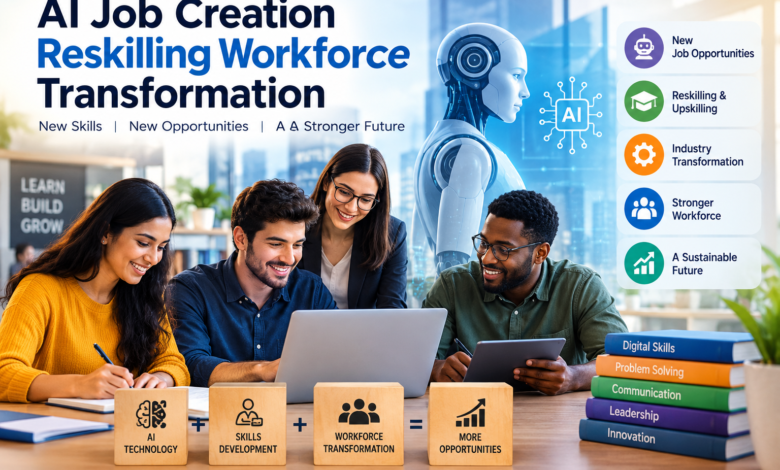
Artificial intelligence is changing how businesses operate, how employees complete tasks, and how organizations prepare for future challenges. From automated customer service to advanced data analysis, AI technologies are creating new opportunities while changing the skills required in traditional occupations. This shift has made ai job creation reskilling workforce transformation an important topic for employers, workers, educators, and policymakers.
Although automation can replace certain repetitive tasks, it can also create demand for new roles, technical expertise, and human-centered skills. Understanding these changes can help individuals and organizations prepare for a workplace where people and intelligent technologies increasingly work together.
How Artificial Intelligence Is Creating New Jobs
AI development has expanded opportunities across technology, healthcare, finance, education, manufacturing, and digital marketing. Companies need professionals who can develop, manage, evaluate, and maintain AI-powered systems.
Emerging opportunities include machine learning engineers, AI product managers, data analysts, AI governance specialists, automation consultants, and professionals who help businesses integrate intelligent tools into existing operations.
The relationship between ai job creation reskilling workforce transformation becomes clearer when businesses introduce new technologies. They often need employees who understand both the technology and the industry’s practical requirements.
For example, a retail company implementing AI-powered inventory management may require data specialists to interpret forecasts and operations managers to apply those insights. Similarly, healthcare organizations may need professionals who understand how to use AI-assisted systems responsibly while maintaining patient safety and privacy.
However, new job creation does not automatically compensate for every position affected by automation. The outcome depends on investment, industry demand, employee training, and how organizations redesign their workflows.
Why Reskilling Is Essential for Employees
Reskilling means learning new abilities to qualify for different responsibilities or career paths. Upskilling, by comparison, involves improving existing skills to perform current work more effectively.
As AI tools become more common, employees may need to develop digital literacy, analytical thinking, problem-solving, communication, and technology-related knowledge.
For workers exploring ai job creation reskilling workforce transformation, practical training can provide a pathway to new opportunities without requiring everyone to become a software engineer.
For instance, an administrative employee might learn to use AI tools for document processing, scheduling, and reporting. A marketing professional could develop skills in AI-assisted research, campaign analysis, and content planning.
The most effective learning programs combine technical knowledge with real-world practice. Short courses, workplace projects, professional certificates, and mentorship can help employees apply their learning to actual job requirements.
How Businesses Can Transform Their Workforce
Organizations need a clear strategy when introducing artificial intelligence. Simply purchasing new software is not enough to achieve meaningful improvements.
Successful workforce transformation begins by identifying tasks that AI can support, evaluating the skills employees already possess, and determining where additional training is necessary.
Businesses can then develop training plans, redesign responsibilities, and establish clear expectations for using AI responsibly.
A thoughtful ai job creation reskilling workforce transformation strategy should involve employees throughout the process. Explaining why changes are happening and offering access to relevant training can reduce uncertainty and encourage participation.
Companies should also assess performance after implementation. Useful measures include productivity, customer satisfaction, error rates, employee engagement, and the time required to complete important tasks.
When employees understand how AI supports their work rather than simply viewing it as a replacement, organizations may find it easier to introduce new processes successfully.
The Importance of Human Skills in an AI-Driven Workplace
Despite advances in automation, human capabilities remain important across many professions. Empathy, creativity, leadership, ethical judgment, negotiation, and complex decision-making are valuable in situations that require understanding context and human needs.
AI can generate recommendations and process large amounts of information, but people must still evaluate outputs, identify potential errors, and make decisions that reflect organizational responsibilities.
This is another important dimension of ai job creation reskilling workforce transformation. Future employees will often benefit from combining digital competence with strong interpersonal and critical-thinking skills.
For example, a healthcare professional may use AI to organize information but still needs clinical judgment and communication skills when discussing treatment with patients. A manager may use predictive analytics while relying on experience and team feedback to make strategic decisions.
A balanced approach recognizes technology as a useful tool while preserving human accountability.
Challenges in Preparing Workers for the Future
Workforce transformation also presents significant challenges. Training programs can be expensive, employees may have limited time to learn, and access to digital education varies across regions and income groups.
Some workers may struggle to identify which skills employers actually need. Others may worry about job security as businesses introduce automation.
To address these concerns, employers should provide accessible learning opportunities, communicate changes honestly, and connect training programs to realistic career pathways.
Governments, educational institutions, and industry organizations can also support workers through vocational programs, affordable digital courses, and partnerships that connect education with employment.
The long-term success of ai job creation reskilling workforce transformation depends on making these opportunities practical and accessible rather than limiting them to highly technical professionals.
Preparing for the Future of Work
Employees can begin preparing by learning how AI tools are used in their industries, strengthening their digital skills, and identifying tasks that may change in the coming years. Building a portfolio of practical projects can also help demonstrate new abilities to potential employers.
Businesses should regularly review workforce needs and invest in continuous learning instead of treating training as a one-time activity.
A forward-looking ai job creation reskilling workforce transformation approach combines technological adoption with employee development, responsible management, and measurable goals.
Conclusion
Artificial intelligence is reshaping employment by automating some tasks, creating new professional opportunities, and changing the skills needed across industries. The challenge is not simply adopting new technology but preparing people to use it effectively.
Through accessible reskilling, thoughtful workforce planning, and continued investment in human capabilities, businesses and employees can respond more confidently to changing job requirements. A balanced approach can help organizations improve productivity while supporting workers as they navigate the evolving world of work.