

Introduction
High-performance computing has become essential for scientific research, artificial intelligence, engineering simulations, and large-scale data analysis. Modern processors and graphics processing units must deliver substantial computational power while moving large amounts of data efficiently. Intel developed Ponte Vecchio, later marketed as the Data Center GPU Max Series, to address demanding workloads in high-performance computing (HPC) and AI.
The intel ponte vecchio fp32 tflops specs topic is particularly relevant to readers comparing GPU computing capabilities. FP32 performance measures the theoretical number of single-precision floating-point operations a processor can perform each second. Understanding this metric alongside memory bandwidth, architecture, and power requirements gives a more complete picture of the hardware.
What Is Intel Ponte Vecchio?
Ponte Vecchio is the former codename for Intel’s Xe-HPC data center GPU architecture. The resulting Data Center GPU Max family was designed for demanding computing environments rather than ordinary gaming computers.
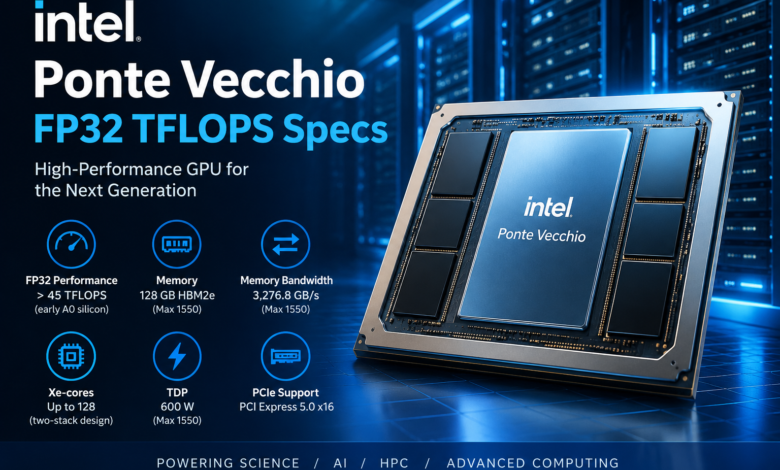
Intel’s early Architecture Day presentation reported more than 45 TFLOPS of FP32 throughput for its A0 development silicon. This figure describes an early implementation and should not automatically be treated as the exact measured performance of every final production configuration.
When researching intel ponte vecchio fp32 tflops specs, it is important to distinguish early architectural demonstrations from specific shipping products. The Data Center GPU Max 1550 and Max 1100 have different numbers of Xe-cores, memory capacities, clock speeds, and power requirements.
Understanding FP32 TFLOPS
FP32 stands for 32-bit floating-point precision, a format commonly used in scientific calculations, simulations, graphics, and machine-learning workloads. TFLOPS means trillions of floating-point operations per second.
For example, a theoretical performance rating of 45 TFLOPS represents approximately 45 trillion FP32 operations per second under the relevant calculation assumptions.
However, peak theoretical throughput does not guarantee the same speed in real applications. Software optimization, memory access patterns, thermal conditions, workload characteristics, and processor utilization all influence actual performance.
The intel ponte vecchio fp32 tflops specs search phrase therefore involves more than a single number. Buyers should consider benchmark results and workload-specific performance when evaluating a GPU for production use.
Architecture and Processing Capabilities
Ponte Vecchio uses Intel’s Xe-HPC microarchitecture, which combines vector processing engines, matrix engines, specialized interconnects, and high-bandwidth memory within a complex multi-tile package.
The Xe-HPC architecture was designed to scale across large computing systems. Its components work together to support parallel processing, data movement, and intensive calculations. Intel’s architecture documentation describes configurations containing up to 128 Xe-cores in a two-stack GPU design.
For people comparing intel ponte vecchio fp32 tflops specs, this architecture matters because compute throughput is only one element of overall performance. Efficient communication between processing units and access to memory can be equally important in large scientific workloads.
The architecture also includes Intel Xe Matrix Extensions, or XMX engines, which accelerate supported matrix operations used in AI and other workloads.
Memory Bandwidth and Capacity
High-performance GPUs need sufficient memory capacity to hold large datasets and enough bandwidth to supply data to processing units efficiently.
The Data Center GPU Max 1550 provides 128 GB of HBM2e memory and approximately 3,276.8 GB/s of memory bandwidth according to Intel’s published specifications. The smaller Max 1100 provides 48 GB of HBM2e memory and 1,228.8 GB/s of bandwidth.
These differences are important when assessing intel ponte vecchio fp32 tflops specs for scientific computing. Larger memory capacity can accommodate bigger datasets, while higher bandwidth can help workloads that frequently transfer data between memory and processing units.
Nevertheless, the benefits depend on the application. Some tasks are limited by computation, while others are restricted by memory bandwidth or data-transfer overhead.
Power Requirements and System Integration
Power consumption is another consideration when deploying data center GPUs. Intel lists a 600-watt thermal design power (TDP) for the Max 1550 and 300 watts for the Max 1100. Both support PCI Express 5.0 x16 connectivity.
These requirements influence server design, cooling, rack density, and operating costs. Organizations planning to deploy this hardware should verify server compatibility, power delivery, cooling capacity, and supported software before purchasing equipment.
The intel ponte vecchio fp32 tflops specs should therefore be evaluated alongside the complete system requirements rather than in isolation.
Applications in High-Performance Computing
Ponte Vecchio was developed for applications such as scientific modeling, numerical simulations, advanced analytics, and AI workloads. These applications can involve enormous datasets and calculations that benefit from parallel processing.
For example, researchers may use data center GPUs for physics simulations, computational fluid dynamics, or complex scientific models. AI developers can also benefit from matrix acceleration when their software and numerical formats are supported.
The intel ponte vecchio fp32 tflops specs provide a useful starting point for understanding theoretical compute capacity, but the best hardware choice depends on the specific software, memory demands, scaling requirements, and benchmark results.
Conclusion
Intel Ponte Vecchio represents an important development in data center GPU architecture, combining Xe-HPC processing resources with high-bandwidth HBM2e memory and advanced packaging.
Intel reported more than 45 TFLOPS of FP32 throughput for early A0 silicon, while production Data Center GPU Max models differ in their configurations and specifications. Understanding these distinctions helps readers interpret published performance figures more accurately.
Anyone evaluating the intel ponte vecchio fp32 tflops specs should compare official model specifications, real-world benchmarks, memory requirements, power consumption, and software compatibility before making a purchasing or deployment decision.